Teaching light and heating topics using everyday experiences
Looking to bring light and heat topics in Physics to life and help learners understand its relevance to their lives? This guidance is a perfect place to start. Designed so the activities and ideas can be woven into your existing schemes of work, it's a practical way to bring a climate and nature lens to your Physics lessons.
How to use the resources
This resource links KS3 concepts to learners’ everyday experiences around school. It explores the greenhouse effect and common misconceptions, helps discover how we can make our environments more heatwave-resilient, and highlights real-world careers where Physics helps address climate change. It does this through a focus on school grounds, where learners can come to appreciate the connection between landscape features and temperature.
It supports lessons on light transmission, absorption, and reflection; energy transfer by light; and human-driven CO₂ emissions and their impact on the climate.
The guide and presentation are designed so you can embed different concepts, ideas and activities into your own schemes of work, bringing a climate and nature lens to your classroom.
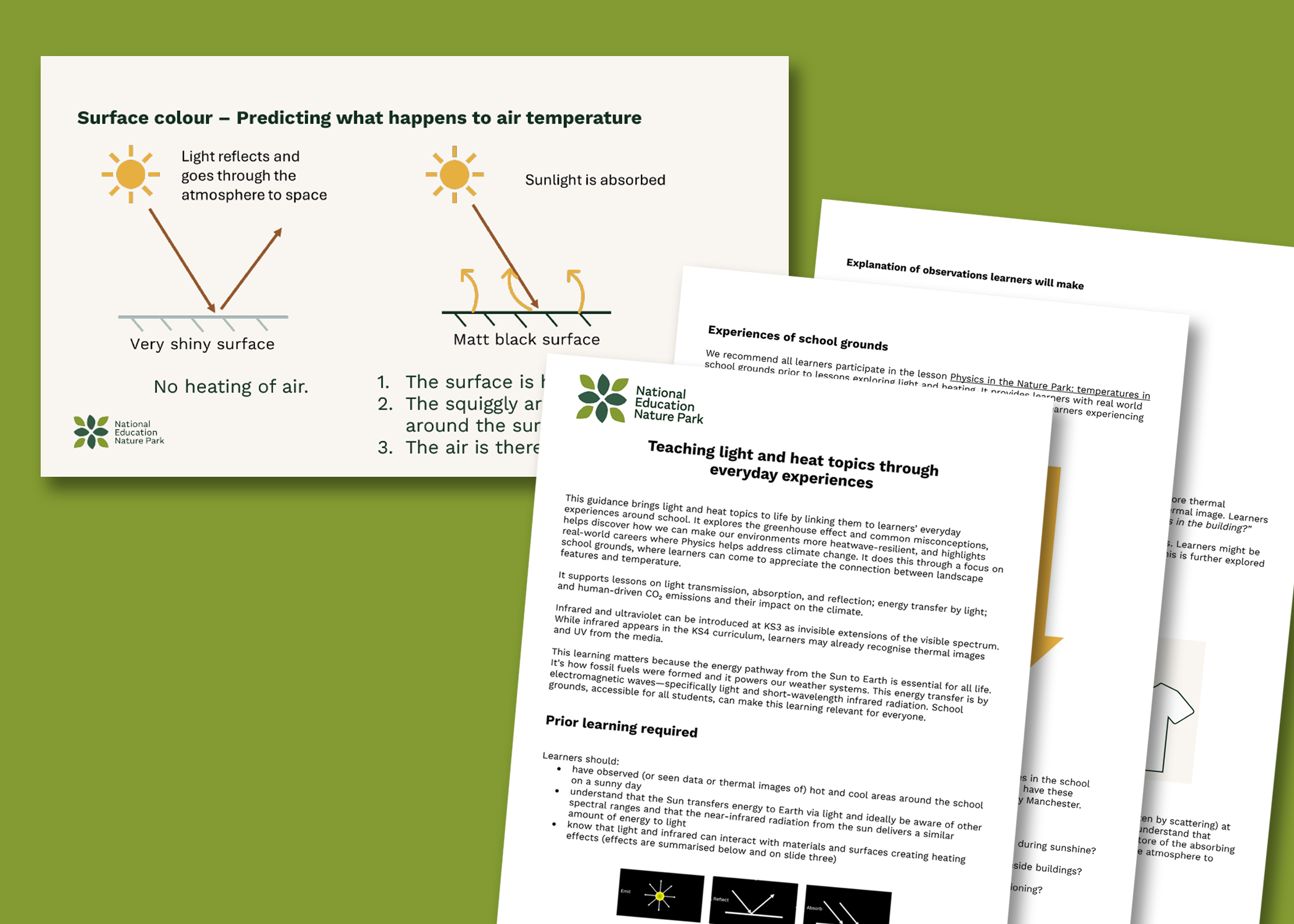
The guidance and presentation include:
- Prior knowledge learners need to understand the concepts in this guidance.
- Light and heat observations learners can make while exploring the school grounds, with images and discussion questions included.
- The physics behind the observations, explained with diagrams to support learners. This covers how colour affects heating, common misconceptions about air and sunlight, and why air temperature varies across the school grounds.
Curriculum links
Experimental skills and investigations
- ask questions and develop a line of enquiry based on observations of the real world, alongside prior knowledge and experience
- make predictions using scientific knowledge and understanding
Energy changes and transfers
- heating and thermal equilibrium: temperature difference between two objects leading to energy transfer from the hotter to the cooler one, through contact (conduction) or radiation; such transfers tending to reduce the temperature difference
Changes in systems
- energy as a quantity that can be quantified and calculated; the total energy has the same value before and after a change
- comparing the starting with the final conditions of a system and describing increases and decreases in the amounts of energy associated with... temperatures...
Light Waves
- the transmission of light through materials: absorption, diffuse scattering and specular reflection at a surface
- light transferring energy from source to absorber...
Matter
- internal energy stored in materials
What to try next