
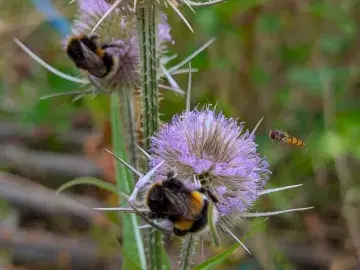
What is a bumblebee?

This presentation supports learners to recognise bumblebees in the wild. Use the images to explore the observable characteristics of bumblebees that set them apart from other insects.

Key learning points include knowing some features that can be used to group together bumblebees, making careful observations and using scientific language to describe those observations.
Lesson plans
KS1
KS2
Science

Preparation

Location

Indoors

Resources

Scaffolding resource

Parts of an insect

Step by step

Starter (slide 3)
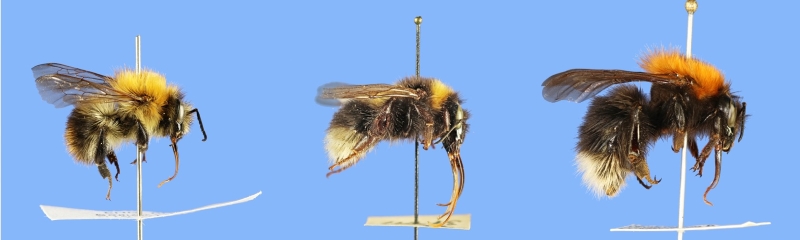
  1. Look at the bumblebees from the Natural History Museum Collection
  2. Learners identify as many similarities as they can. Alternatively, learners could pick their favourite bumblebee, discuss which bumblebee they think might make a good friend or describe what they like about a bumblebee. This is to get learners into the habit of looking for details, so at this stage, similarities or reasons can be any features they notice about the bumblebees.  
Parts of a bumblebee (Slides 4-6)
  1. Introduce the parts of an insect and details that distinguish bumblebees from other insects.
  2. Look at the top-down photos of bumblebee specimens and learners describe as many similarities as they can, using the correct terms for the parts of a bumblebee as much as they can.
How to recognise a bumblebee outdoors (Slides 7-11)
  1. Often, the scientific features above are difficult to use when looking at insects flying around outside. In these situations, scientists can look for other, more obvious clues to help them quickly recognise bumblebees.
  2. Introduce the features which can be used to quickly separate bumblebees from other insects.
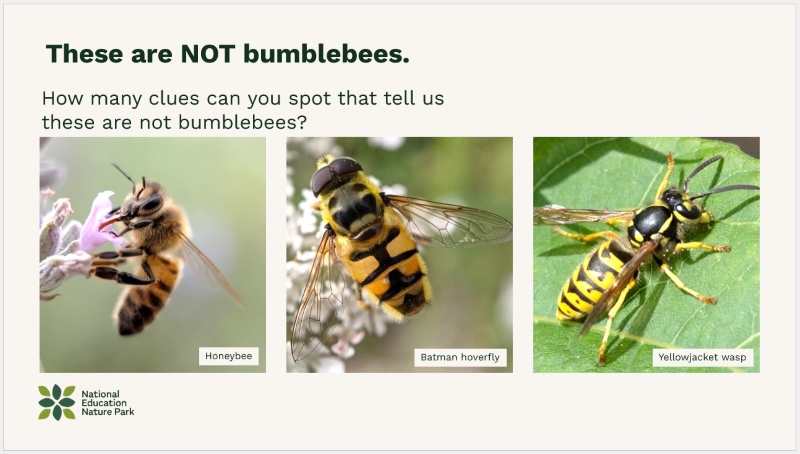
  3. Use the photos of bumblebee-like insects to practice identifying which are bumblebees.
Challenge 1 (Slide 11)

Look at the images of a honeybee, hoverfly, and wasp. Learners list as many clues as they can that indicate that these are not bumblebees.
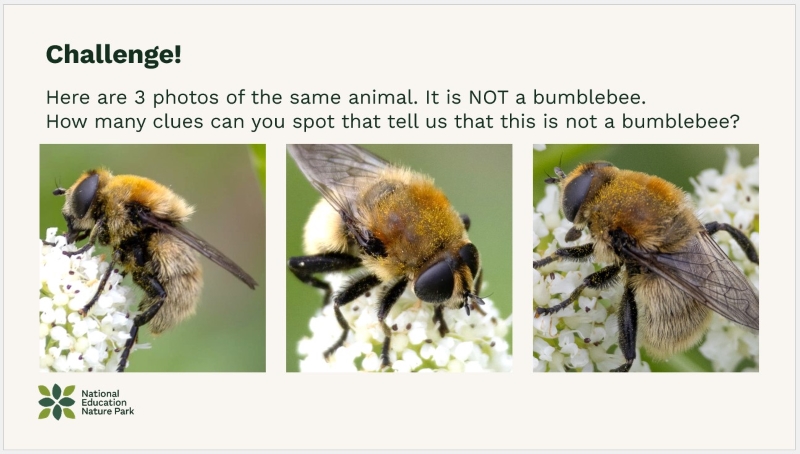
 

Challenge 2 (Slide 13)
  1. Look at the images of the narcissus bulb fly.
  2. Learners list as many clues as they can that indicate that these are not bumblebees. 
    Potential answers and more information are included in the slide notes.