
Their Royal Highnesses The Prince and Princess of Wales meet Nature Park students
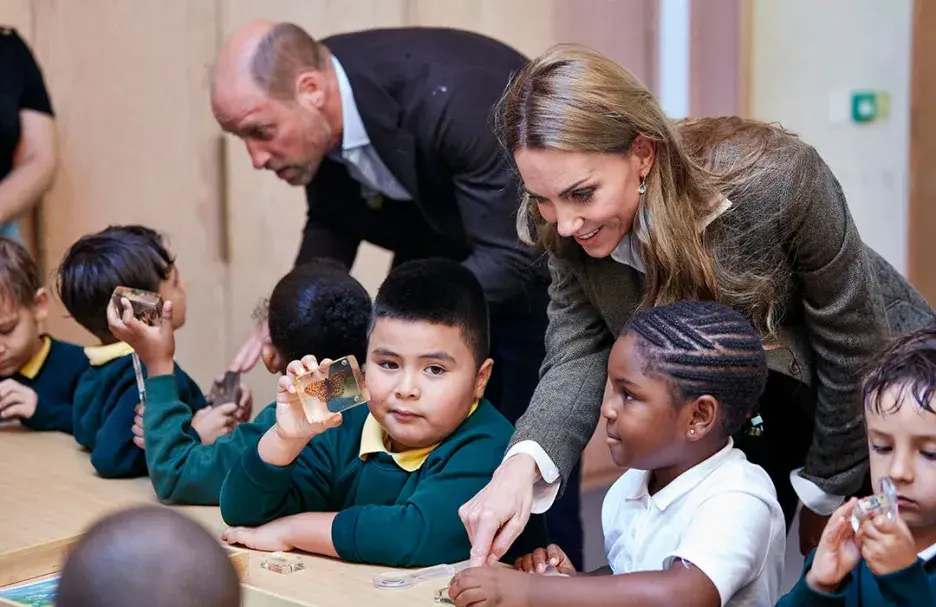
Students explained the actions they are taking as part of the National Education Nature Park, a free programme from the Department for Education delivered by the Museum for all schools, nurseries and colleges in England empowering children to improve their outdoor spaces for both people and wildlife.
7,500 education settings have registered for the National Education Nature Park programme so far, more than 25% of all primary and secondary schools in England
Since their transformation and reopening in July 2024, the Natural History Museum’s gardens have welcomed over five million visitors
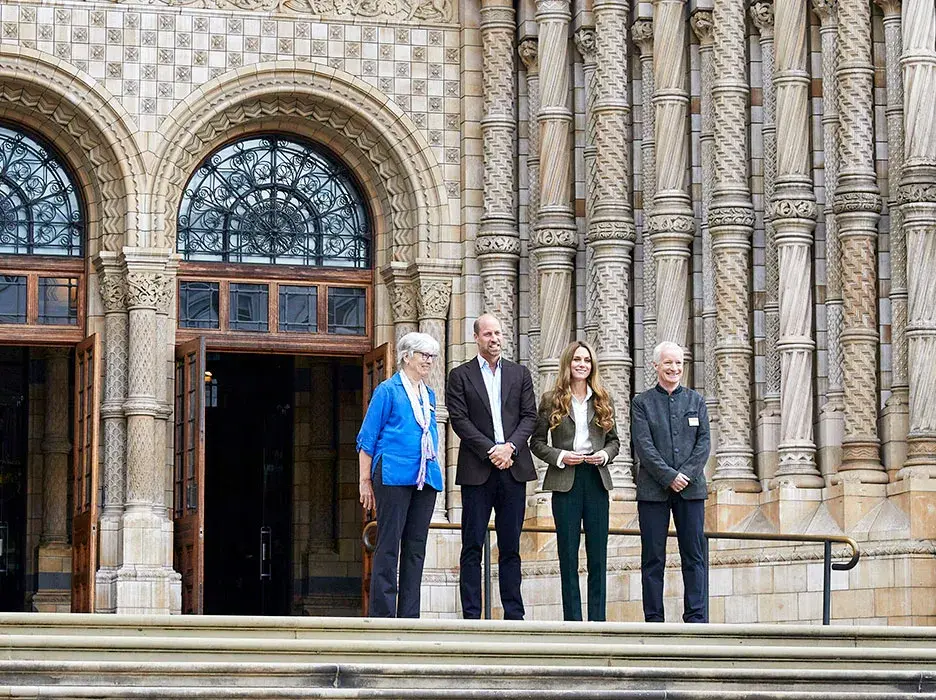
Their Royal Highnesses The Prince and Princess of Wales visited the Natural History Museum’s gardens today, where they heard from students transforming their school grounds from ‘grey to green’ through the National Education Nature Park programme
Her Royal Highness The Princess of Wales, who has been Patron of the Museum since 2013, and His Royal Highness The Prince of Wales, were joined by Museum Director Dr Doug Gurr and Museum Botany Researcher and Acting Director of Research Dr Sandra Knapp and together explored the newly developed gardens. After passing Sir David Attenborough’s compelling words, ‘The future of the natural world, on which we all depend, is in our hands’ cast in bronze lettering outside the Museum’s main entrance they headed to the Nature Discovery Garden, supported by the Cadogan Charity. This area of the gardens serves as a living laboratory for the Museum’s 400 scientists, making it one of the most intensively studied urban nature sites in the world.
Their Royal Highnesses joined local children from Kender Primary School, Lewisham school taking part in Museum learning activities, before meeting students from Co-op Academy Manchester who have been creating new habitats on their school grounds. These actions are part of the National Education Nature Park programme, which the Department for Education have created to bring the Museum's work of connecting people with nature, and bringing nature into urban environments, to children across the country.
This education programme, commissioned and funded by the Department for Education, led by the Natural History Museum working with the RHS, inspires action among thousands of young people across England who are turning the ‘grey’ parts of their playgrounds into greener spaces by creating new habitats that benefit both wildlife and the school community.
Speaking about the visit, Dr Doug Gurr said: “It’s been a pleasure to welcome Their Royal Highnesses to the Museum gardens today and share how our outdoor galleries are contributing to scientific understanding of urban nature. It was fantastic to introduce them to young people who are making a difference for nature as part of the National Education Nature Park programme which already has over a quarter of schools in England on board, putting nature and climate at the heart of education.”
The English school estate covers an area roughly twice the size of Birmingham, and little is currently known about what lives and grows across it. Through the National Education Nature Park, children and young people are filling in the gaps in this scientific knowledge by collecting data on their sites and unlocking their space’s potential by creating new habitats there, providing homes for local species, supporting student and staff wellbeing and generating outdoor learning opportunities.
Richard Simpson, a Senior Science Technician & STEM Lead at Co-op Academy Manchester, said: "Their Royal Highnesses were really interested to hear about how we built a living green wall on a technology classroom which gets very hot in the summer, and how we've used thermal imaging cameras in Physics lessons to show that it's up to ten degrees cooler on the wall where we've got plants growing.”
The free programme is open to all schools, colleges and nurseries in England: www.educationnaturepark.org.uk
The Nature Park programme created by the Department for Education is part of wider government work to make sure that all children and young people have access to a variety of enrichment opportunities at school as an important part of the mission to break down barriers to opportunity. The programme is backed by £15 million in grant funding to specifically support schools in disadvantaged and nature-depleted areas to transform their grounds into greener spaces where children can connect to nature and play.
The gardens are central to the Museum’s mission to inspire over 100 million advocates for the planet, supporting its scientific work and public engagement. This ambition is being realised through the transformation of the South Kensington site and major programmes like Fixing Our Broken Planet, the Urban Nature Movement, and Wildlife Photographer of the Year.
To help achieve this vision ahead of its 150th anniversary in 2031, the Museum has launched NHM150, a campaign to raise £150 million. NHM150 is already delivering results, enhancing the visitor experience and drawing record audiences, with over 6.3 million visitors last year. By 2031, the Museum will unveil two new galleries and transform four more, creating inspiring spaces to showcase the natural world and embed scientific expertise at the heart of the visitor experience.
-ENDS-
Natural History Museum Press Office
Tel: +44 (0)20 7942 5654 / 07799690151
Email: [email protected]
About The Natural History Museum
The Natural History Museum is a world-leading scientific research centre and one of the world’s most visited museums. Our mission is to create advocates for the planet – people who act for nature.
Our 400 scientists are finding solutions to the planetary emergency - from reversing biodiversity loss to resourcing the green economy.
We are seeking an additional £150 million to transform our South Kensington building: placing our groundbreaking research at its heart, revitalising four existing galleries, opening two new magnificent galleries and delighting 1 million more visitors a year with the wonders of the natural world.
Supporters and Sponsors of the Museum gardens and the Urban Nature Project
A wide variety of trusts, foundations, companies and individuals are supporting the Urban Nature Project including Amazon Web Services, The National Lottery Heritage Fund, Evolution Education Trust, The Cadogan Charity, Garfield Weston Foundation, Kusuma Trust, the Wolfson Foundation, Charles Wilson and Rowena Olegario, Royal Commission for the Exhibition of 1851, Clore Duffield Foundation, Workman LLP and Accenture.
Amazon Web Services
Since 2006, Amazon Web Services (AWS) has been the world’s most comprehensive and broadly adopted cloud. To learn more about AWS, visit aws.amazon.com.
The National Lottery Heritage Fund
Our vision is for heritage to be valued, cared for and sustained for everyone, now and in the future. That’s why as the largest funder for the UK’s heritage we are dedicated to supporting projects that connect people and communities to heritage, as set out in our strategic plan, Heritage 2033. Heritage can be anything from the past that people value and want to pass on to future generations. We believe in the power of heritage to ignite the imagination, offer joy and inspiration, and to build pride in place and connection to the past.Over the next 10 years, we aim to invest £3.6billion raised for good causes by National Lottery players to make a decisive difference for people, places and communities. heritagefund.org.uk. Follow @HeritageFundUK on Twitter/X, Facebook and Instagram and use #NationalLottery #HeritageFund
Evolution Education Trust
The Evolution Education Trust helps raise awareness of the importance of the Theory of Evolution by funding impactful projects in the areas of therapeutics, education, conservation and fundamental research.
The Cadogan Charity
The Cadogan Charity supports communities, contributes to a sustainable environment and protects heritage. It has supported charities involved in animal welfare, education, conservation and the environment, military, medical research and social welfare.
Garfield Weston Foundation
Established in 1958, the Garfield Weston Foundation is a family-founded grant-maker that gives money to support a wide variety of charities across the UK. The Foundation’s funding comes from an endowment of shares in the Weston family business – a successful model that still exists today. The Weston family has a consistent aim. The more successful the family businesses, the more money the Foundation can donate.
Each year the Foundation gives away its income and donations have continued to grow. Since it was established, it has donated over £1.5 billion, of which over half has been given away in the past ten years. In the most recent financial year the Foundation gave away around £130 million to nearly 3,000 charities across the UK.
Kusuma Trust
Kusuma Trust UK is a family led philanthropic trust established in 2010. The Trust gives grants to organisations based on shared values and mutual interests in the UK, Gibraltar and India. Since inception, Kusuma Trust has made significant contributions in the areas of health, education and culture through capital, programme and research grants.
The Wolfson Foundation
The Wolfson Foundation is an independent charity with a focus on research and education. Its aim is to support civil society by investing in excellent projects in science, health, heritage, humanities and the arts.
Since it was established in 1955, some £1 billion (£2 billion in real terms) has been awarded to more than 14,000 projects throughout the UK, all on the basis of expert review.
X: @wolfsonfdn
Royal Commission for the Exhibition of 1851
The Royal Commission for the Exhibition of 1851 was established in 1850 to organise the Great Exhibition. The Exhibition made a significant surplus which the Commission, under the guidance of Prince Albert, used to purchase an estate in South Kensington. This estate has developed to become a centre of scientific, cultural and educational excellence which now houses the Natural History, Science and V&A museums; Imperial College London; the Royal Colleges of Art and Music; and the Royal Albert Hall, all of which the Commission continues to support in their work in education, research, science and the arts. Today, it is focussed predominantly on awarding postgraduate Fellowships and Scholarships, for advanced study and research in science, engineering, the built environment and design. It also awards grants to support projects consistent with its overall aims, many of which are focused on raising the awareness of the young to the opportunities presented by science and engineering.
Clore Duffield Foundation
The Clore Duffield Foundation, established by Sir Charles Clore in 1964, celebrated its 60th anniversary in 2024.
Now chaired by Sir Charles Clore’s daughter, Dame Vivien Duffield, the Foundation supports UK charities working in the arts, education, social welfare and health.
Workman LLP
Workman LLP is the UK’s largest independently owned commercial Property Management and Building Consultancy firm, employing more than 850 staff across 11 UK offices, with a growing presence in Europe. Professional Property Management and Building Consultancy teams work with a client base which includes leading institutional funds, overseas investors, and property companies. What sets Workman apart from the competition is its specialist focus, national coverage, and independent status. For further information, visit workman.co.uk or to find out more about Workman’s drive to build biodiversity across its managed portfolio, visit www.workman-building-biodiversity.co.uk.
The National Education Nature Park - partners for nature
The National Education Nature Park has been commissioned by the Department for Education, and is delivered by a partnership led by the Natural History Museum with the Royal Horticultural Society supported by Learning Through Landscapes, UK Centre for Ecology and Hydrology, National Biodiversity Network Trust, the Royal Geographical Society (with IBG), Royal Society and Manchester Metropolitan University. Esri UK is the geospatial technology partner in the programme, providing the digital mapping platform.
Department for Education’s sustainability and climate change strategy
Following the publication of its Sustainability and Climate Change Strategy, the Department for Education has commissioned three initiatives that support education settings on their sustainability journey and embed climate and nature into everyday teaching and learning.
These complementary initiatives include access to support to get started or prioritise next steps on the sustainability journey through the online Sustainability Support for Education service; access to experts to help planning and delivery of climate action plans through the Climate Ambassadors programme and the Let’s Go Zero Climate Action Advisors; and digital tools and resources to empower children and young people to lead the way in decision making and action in their setting as part of their journey through the National Education Nature Park.
About the RHS
Since our formation in 1804, the RHS has grown into the UK’s leading gardening charity, touching the lives of millions of people. Perhaps the secret to our longevity is that we’ve never stood still. In the last decade alone we’ve taken on the largest hands-on project the RHS has ever tackled by opening RHS Garden Bridgewater in Salford, Greater Manchester, and invested in the science that underpins all our work by building RHS Hilltop – The Home of Gardening Science.
We have committed to being net positive for nature and people by 2030. We are also committed to being truly inclusive and to reflect all the communities of the UK.
Across our five RHS gardens we welcome more than three million visitors each year to enjoy over 34,000 different cultivated plants. Events such as the world famous RHS Chelsea Flower Show, other national shows, our schools and community work, and partnerships such as Britain in Bloom, all spread the shared joy of gardening to wide-reaching audiences.
Throughout it all we’ve held true to our charitable core – to encourage and improve the science, art and practice of horticulture –to share the love of gardening and the positive benefits it brings. For more information visit www.rhs.org.uk.
RHS Registered Charity No. 222879/SC038262
About Esri UK
Esri UK is a GIS (Geographic Information System) software company, developing a range of geospatial solutions for digital mapping and spatial analysis. Customers include the Environment Agency, Cabinet Office, Vodafone and the National Trust. The company’s Education programme provides free access to its ArcGIS software, teaching resources and training for all UK schools. Currently used by over 3,500 schools and 135 universities across the UK, Esri’s software helps students learn new skills.
For more information please visit: www.esriuk.com
About Learning Through Landscapes
Learning through Landscapes is the UK’s leading outdoor learning and play charity, with a UK-wide team of experienced outdoor educators and school grounds designers. Our vision is a society where outdoor learning and play are recognised as a fundamental part of education and every child benefits from regular time outdoors as part of their school day. Our work is dedicated to supporting schools in achieving this vision through three main avenues:
We provide resources, training, and funding to help educators develop the skills and confidence to deliver curriculum-led outdoor learning and high-quality outdoor play at school.
We champion the importance of rich outdoor environments for learning and play, supporting the development of climate-ready, future-proof school grounds through our projects and consultation work.
Through projects like My School, My Planet, we nurture nature connection in children by providing valuable outdoor experiences to pupils who typically spend the least time in the natural world.
For over 30 years, we’ve been at the forefront of developing and delivering innovative projects, supporting schools and early years settings with our unrivalled knowledge and expertise. We work closely with partners across the UK and internationally to advocate for outdoor learning and play in every school day, helping every child enjoy the benefits of learning and playing outdoors.
About the UK Centre for Ecology and Hydrology
The UK Centre for Ecology & Hydrology (UKCEH) is a leading independent research institute dedicated to understanding and transforming how we interact with the natural world. With over 600 researchers, we tackle the urgent environmental challenges of our time, such as climate change and biodiversity loss. Our evidence-based insights empower governments, businesses, and communities to make informed decisions, shaping a future where both nature and people thrive.
About the National Biodiversity Network Trust
The National Biodiversity Network (NBN) Trust is a small charity with a big plan – to make data work for nature. For more than twenty years we’ve been making biodiversity data accessible, to support better decisions about the natural world and to connect people with nature. But there’s so much more to do – and the urgency is greater than ever. It’s estimated that as little as 50% of existing biodiversity data is available to those who need it. If we’re to succeed in reversing the collapse of biodiversity, our decisions must be based on the most complete and highest-quality evidence. This is where the NBN Trust, our network and our members have a unique and vital role to play.
https://nbn.org.uk/ https://nbnatlas.org
About the Royal Geographical Society (with IBG)
The Royal Geographical Society (with the Institute of British Geographers) is the learned society and professional body for geography. Formed in 1830 for 'the advancement of geographical science', today we deliver this objective through developing, supporting and promoting geographical research, expeditions and fieldwork, education, professional practice, public engagement, and geography input to policy. We aim to foster an understanding and informed enjoyment of our world. We hold the world's largest private geographical collection and provide public access to it. We have a thriving Fellowship and Membership and offer the professional accreditation 'Chartered Geographer’. www.rgs.org
About the Royal Society
The Royal Society is a Fellowship of many of the world’s most distinguished scientists drawn from all areas of science, engineering, and medicine. The Society’s fundamental purpose, as it has been since its foundation in 1660, is to recognise, promote, and support excellence in science and to encourage the development and use of science for the benefit of humanity. http://royalsociety.org/
Follow the Royal Society on Twitter (@royalsociety) or on Facebook (facebook.com/theroyalsociety)
About Manchester Metropolitan University
Manchester Metropolitan University is making an impact on Manchester, the UK and beyond, with a driving ambition to discover and disseminate knowledge, and make higher education accessible and beneficial to all those with the passion and ability to succeed. The University, which is celebrating its 200th anniversary this year, is home to 43,000 students with an alumni network of more than 340,000 graduates. 90% of its research is rated as ‘internationally excellent’ and it has been rated in the top three most sustainable universities in the UK for the past 11 years.