
Community science: five success stories to fuel your Nature Park journey
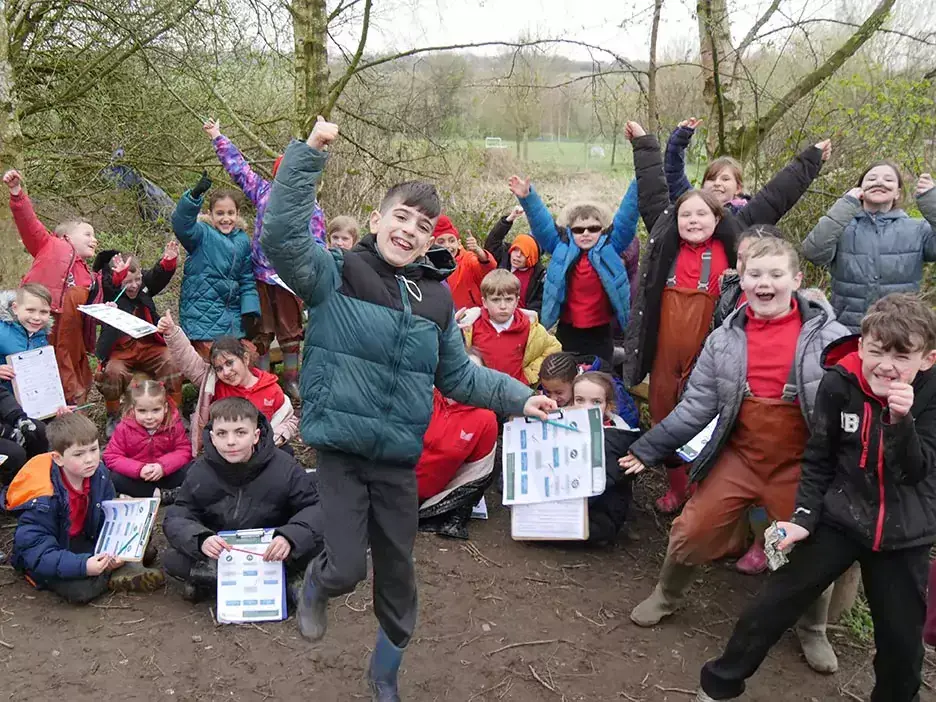
As well as an education programme, the Nature Park programme is a huge community science project contributing to trailblazing research into global biodiversity.
When you get involved, you become part of this huge team across the country working on this vital science. In this blog, we share five community science success stories from other projects to show the power of working together and inspire your own Nature Park journey.
What is community science?
Community science is when people from all walks of life team up with scientists to conduct real scientific research and drive discovery. Anyone can be a community scientist, from children and young people and teachers to community groups and members of the public. And you don’t need a lab coat to take part!
Community scientists bring science to life, they ask questions, they collect and analyse data, design projects and they find out what science can tell them about their local places. Without community scientists we would know far less about the natural world.
Have a guess - which of these Nature Park activities are community science activities and contributing to real scientific research? (answers at the bottom of the blog!)
As a research approach, community science is as varied as the people who get involved. It is particularly well suited to educational settings as it shows children and young people that scientific knowledge is gained through curiosity and inquiry.


“Once upon a time…” - school children publish a unique scientific paper
An original scientific experiment was designed, conducted and written up by school children aged 8-10 from Blackawton Primary School in Devon.
The experiment tested bumblebee intelligence. Children trained bumblebees to choose yellow ‘flower’ circles when surrounded by blue circles and vice versa. Later, they tested if the bumblebees remembered their training by changing the locations, colours and patterns. The bees got it right 90% of the time! Three out of five bees followed the original colours while two out of five followed the original locations, showing that bees can learn to solve puzzles and remember it in different ways.
The researcher on the project wrote up the children’s words in a scientific paper and it was published in a leading journal – it’s well worth a read!
“We discovered that bumblebees can use a combination of colour and spatial relationships in deciding which colour of flower to forage from. We also discovered that science is cool and fun because you get to do stuff that no one has ever done before.”

Discovering the ‘bear’ necessities
In a mass community science project, 30,000 school children aged from 7 to 16, ventured out to forests, parks and cemeteries across Denmark to map micro-flora and fauna. They measured ammonia in the air, took precise GPS coordinates and collected over 8,000 moss and lichen samples in the hope of gathering tiny microscopic creatures called water bears.
According to the Natural History Museum in Denmark, “no attempt had ever been made to map the water bear fauna of an entire country in one comprehensive study.”
The project’s coordinator stated that “over 60 percent of the students involved are now more interested in science than before the study. The students are motivated by engaging in authentic scientific inquiry methods – especially when they carry them out in real-world settings and in the field.”
On top of this astounding impact, their efforts quadrupled the known water bear species in Denmark. Out of the 55 species found, only 14 had been previously recorded in the country, and the students discovered not one but nine species completely new to science!

High schools change how climate is monitored
A network of 70 accurate weather stations is managed by high schools across the Flanders, Belgium, to study the interactions between land use and weather at a local scale.
In this trailblazing project, schools took charge by proposing suitable locations, assembling and installing weather stations, collecting weather data and even doing data analysis.
Reliable weather stations are usually located in rural areas from where it is difficult to measure local impacts such as the urban heat island effect or the impact of water bodies near cities.
Schools placed their weather stations in a range of unique landscapes, including non-traditional urban and industrial areas, in forests and by lakes. These unique locations enabled the collection of incredibly accurate local weather data that would otherwise be missed by global climate models.
Schools have taken ownership of their weather stations: they have linked up with local partners and stakeholders, share their data on an interactive dashboard, and students are now using the data to write their own research projects.

A teacher makes an astronomical discovery
Dutch school teacher Hanny van Arkel decided to take part in an online community science project, Galaxy Zoo, that involves looking of pictures of galaxies and identifying them based on their shape. The consensus of enough community scientists results in incredibly accurate galaxy classifications.
In one of the pictures, Hanny saw and classified a galaxy but then noticed something else under it. After further investigation, it turned out to be a brand-new astronomical object, completely unknown to scientists, and roughly the size of the Milky Way!
It has been named “Hanny’s Voorwerp”, Dutch for “Hanny’s Object”. It has no stars but still glows brightly. It has taken years for scientists to piece together what it could be and it has been photographed by the Hubble Space Telescope. The leading theory is that it is a rare object called a light echo: a cloud of gas that is still glowing from being hit by a powerful radiation from a black hole at some point in the last 200,000 years.
This incredible discovery has offered new insights and informed debates about the interactions between galaxies and radiations from black holes that we’d otherwise still be in the dark about.

Creating playgrounds for pollinators
The Polli:Nation project led by Learning Through Landscapes was one of the pre-cursors of the Nature Park and shared a similar mission!
Schools across the UK carried out pollinator surveys and turned their grounds into pollinator-friendly habitats. Over 1,000 surveys were carried out (58% by primary schools and 16% by secondary schools), recording a total of 18,886 pollinators and 14,500 metres squared of wildflowers over 66 hours (or 20 school days).
The main aim of was to make improvements to the outdoor areas where children learn, and to measure if those improvements benefit pollinators, by surveying learning sites before and after.
Following improvements, there was a significant increase in the area of pollinator feeding habitat and significantly more pollinators were recorded (an average of 7.7 insects per 1 metre squared compared with 4.3 before). Creating damp places and planting wildflowers had the greatest positive impact on total pollinator diversity.
On top of this huge impact for pollinators, the proportion of participants with previous experience of identifying insects rose by 22% as a result of taking part.
Polli:Nation proved that schools can collect real scientific data on pollinators, create pollinator-friendly habitats on site, and crucially, use evidence to demonstrate their improvements worked.
Everyone who took part in these projects is a community scientist!
And yes, everyone on the Nature Park project who has drawn a habitat map, submitted a picture to iNaturalist or done a Pollinator Count is a real community scientist taking action for nature.
As the programme grows, even more surveys will become available for you to take part in even more community science through the Nature Park.
Want to get started on some Nature Park community science now?
Map your habitatsRecord wildlife on your site with iNaturalist
Answers to the quiz:
1. Habitat mapping
Yes! Habitat mapping is the essential first step to create a baseline for your site and use evidence to understand what habitats are already there and how you might improve them for nature. Did you know the entire biodiversity of your grounds can be estimated from a simple habitat map?
2. Hidden Nature Challenge
No, this isn’t directly contributing to scientific research, however it’s a fantastic activity to explore nature in unexpected places.
3. Pollinator Count
Yes! The Pollinator Count is a real biodiversity survey that enables you to collect scientifically robust data on how pollinators are doing on your site, so that you can use evidence to make the best choices for them. It’s best done a handful of times in different habitats.
4. Sound mapping
No, this isn’t directly contributing to scientific research but encourages you connect to the nature and sounds on your site. Activities that develop connection with nature can improve wellbeing and encourage care for the environment.