Leaf vocabulary
An introduction to the vocabulary used to describe parts of a leaf. Key learning points also include the importance of using specific vocabulary to describe leaves.
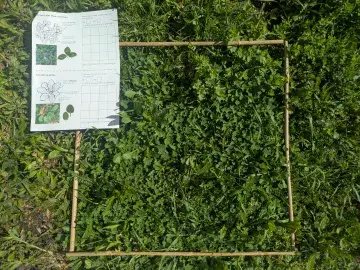
These resources can also be used to prepare learners for doing the Grassland Plant Survey.
Preparation
Location
Indoors
Step by step
Activities for free exploration of leaves
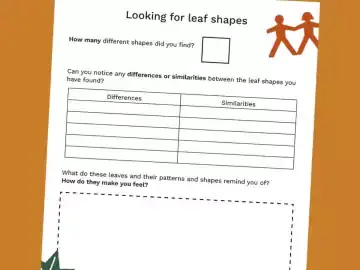
Looking for leaf shapes
Begin activityLeaf identification
Begin activityLearning objectives (Slide 2)
- I can describe a leaf using specific vocabulary.
- I can recognise a leaf based on a description.
Introduction: dandelions (Slides 3-8)
- Introduce some ways that dandelions are used by people.
- Learners look at the images of dandelion leaves and list as many similarities as they can.
- Use the similarities identified to write a description of a dandelion leaf that works for all three leaves.
Leaf vocabulary (Slides 9-16)
Vocabulary to describe different parts of a leaf.
Practice using vocabulary (Slides 17-20)
- Revisit dandelion leaf images and use the leaf vocabulary to write a description that works for all three leaves.
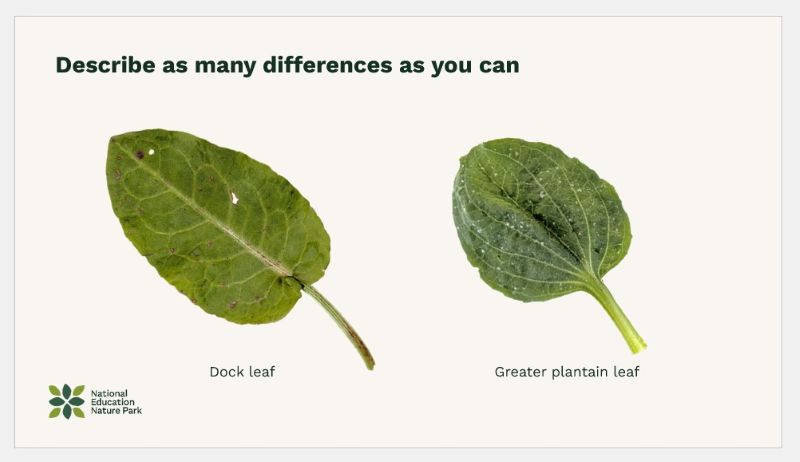
- Look at the dock and greater plantain leaf. Use the leaf vocabulary to identify differences between these leaves.

Extra detail (Slides 21-23)
Optional extra information about how to tell if you are looking at a whole leaf or a leaflet (part of a compound leaf).
Activities for practising leaf vocabulary (Slides 24-26)
Describe and draw
Learners take turns describing and drawing leaves. They can then reflect on how they described their leaf and how their description was interpreted. How could they change their description to produce a more accurate result?
Searching or prompting
Even with modern technology, search terms and AI prompt engineering are important skills that require the use of detailed descriptive vocabulary. Describe a leaf in a search engine or generative AI model and see what it returns. Does more specific and descriptive language improve results?
Curriculum links
Working scientifically
- observing closely, using simple equipment
- identifying and classifying
Plants
- identify and name a variety of common wild and garden plants, including deciduous and evergreen trees
- identify and describe the basic structure of a variety of common flowering plants, including trees
Working scientifically
- observing closely, using simple equipment
- identifying and classifying
Living things and their habitats
- identify and name a variety of plants and animals in their habitats
Working scientifically
- making systematic and careful observations
- recording findings using simple scientific language, drawings, labelled diagrams
Plants
- identify and describe the functions of different parts of flowering plants: roots, stem/trunk, leaves and flowers
What to try next
Habitat mapping: a Nature Park guide
Begin activity