Will planting wildflowers attract pollinators? Let’s explore the evidence!
What does the Nature Park science team do? Meet us here!
- We create the nature surveys so you can track biodiversity on your site 🌿
- We develop and improve the digital tools to enhance your Nature Park journey 🌍
- We calculate the overall biodiversity across all schools in the Nature Park 🐝
We also gather evidence to predict the biodiversity gains we expect to see in settings taking part in Nature Park. This is called ‘meta-analysis’ - let’s take a deeper dive!
Scientists read and share their research through scientific papers. Meta-analysis is a systematic way of drawing out the results from many scientific papers and summarising them to create a consensus.
How do we find the answers?
Alexa is our researcher leading on the meta-analysis. For each habitat enhancement, such as planting wildflowers, Alexa gathers as many relevant papers as she can find that have measured the effect of wildflowers on biodiversity.
Each paper might have compared different enhancements and measured their impact using different metrics. Each individual interaction counts as a separate ‘effect size’. If a study counted butterflies and bees in wildflower strips compared to grassy areas and to cereal fields, there would be 4 ‘effect sizes’:
- comparing wildflower vs grass areas (butterflies)
- comparing wildflower vs grass areas (bees)
- comparing wildflower vs cereal fields (butterflies)
- comparing wildflower vs cereal fields (bees)
To hold all this data from different papers, Alexa has created a big spreadsheet (we’re talking 78 columns wide, and over 3000 rows long!). In it, she collects data about these broad categories:
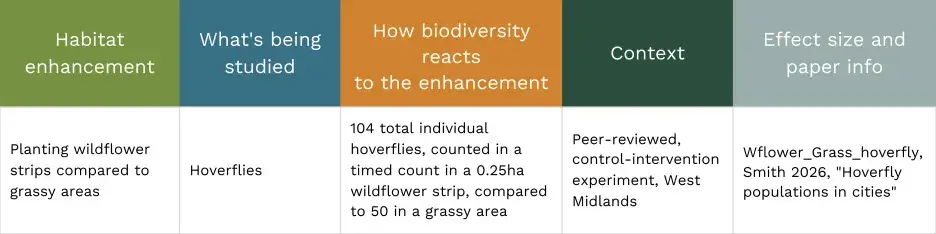
And so on – each ‘effect size’ is a separate row. Alexa uses the data in the orange category above to calculate how big the impact of the habitat enhancement was.
It’s a lot of work to do, so Alexa brought in extra help. Together with Masters students Ruby and Yi and many other PhD students, they extracted data on the topic of wildflowers. They found studies from across the world. Here are the ones they have got data from so far:
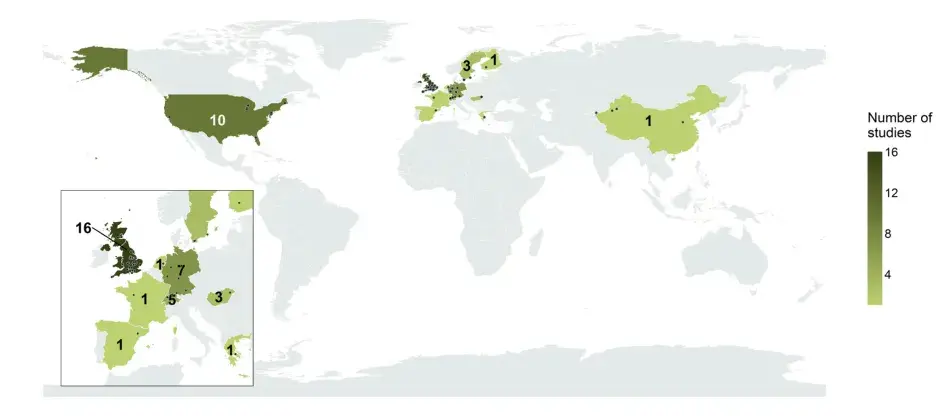
Figure 1. A map showing where the studies in the dataset come from. Points show locations where data were collected; numbers indicate how many studies there are from each country.
As you can see, most of the studies so far are from Europe. They used a programming language called R to analyse these data.
What the evidence says
From all this evidence, Alexa has found that, on average, planting wildflowers boosts overall biodiversity by 229%! This figure will change as more data comes in.
Planting small wildflower patches benefits urban pollinators
Looking at insect pollinators (e.g. bees, hoverflies) specifically, Ruby found that planting a small patch of wildflowers in urban habitats like a school site can increase the total number of pollinators by 109% and the number of pollinator species by 46%. Adding wildflowers to your site has huge potential to increase the number and range of pollinators!
Do bees respond to small wildflower plantings in different ways?
Yi used a subset of the data to look specifically at bees. She found that local-scale wildflower planting significantly increased bee diversity, with a strong increase in total number of bees and a smaller but still significant increase in the number of different bee species. Let’s look at how this varied by context.
Urban vs rural
When looking at all biodiversity metrics together, urban and rural contexts showed the same increase in bee biodiversity, so planting wildflowers can be just as effective in cities as in the countryside! When Yi looked at just one metric, the number of different bee species, it increased more strongly in urban areas – so if your site is in an urban area, you could have an even bigger impact in supporting a healthy variety of bee species.
Zooming out and using the whole dataset (overall biodiversity), Alexa found these values:
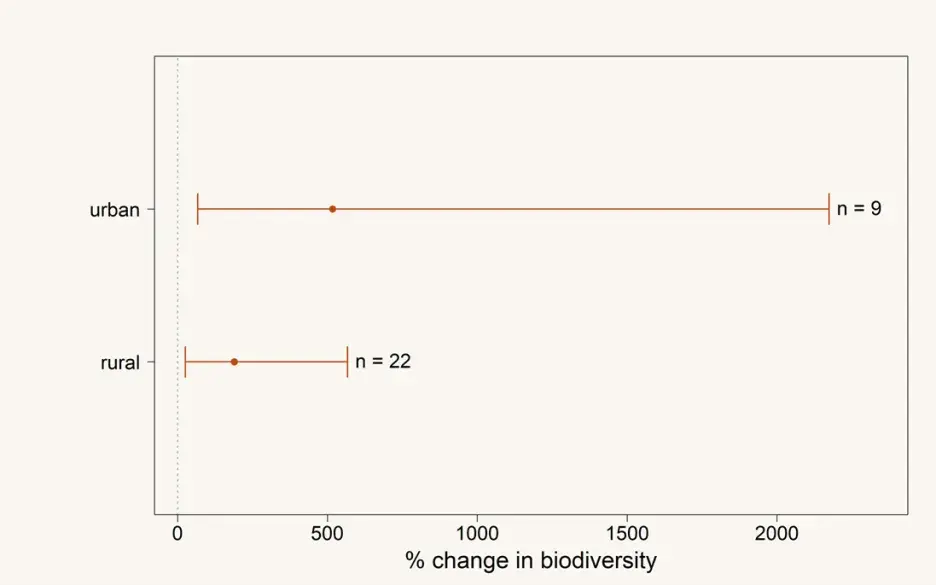
Figure 2. The impact of flower planting in urban versus rural contexts. The ‘n =’ is the number of studies in each group. The dot in the middle of the line shows the average estimated increase, and the lines show the range of values that would not be surprising given our dataset. The shorter the lines, the more confident we are of the results.
Does size matter?
No, the size of the habitat enhancement does not have an effect and the size alone is unlikely to be the primary driver of outcomes on bee diversity. No matter how big or small, your wildflower patch will increase bees on your site!
Does surrounding nature make a difference?
Yi looked at how semi-natural habitat affects bees’ response to flower planting. Overall, enhancements were more effective when there was little surrounding natural habitat. This means that if you don’t have much green around, your site has even greater potential to become a local oasis for bees.
Take a look at your habitat map and explore your surrounding area – can you see any local parks, nature reserves, riverbanks or other natural habitats? How could you link up to those habitats, or plant wildflowers to complement them (for example that bloom at different times to provide a longer feeding season for pollinators)?
In summary
Alexa, Ruby and Yi are data-management superheroes! 💫
- The potential biodiversity gains of planting wildflowers in urban habitats (like school sites) are huge!
- Urban vs rural? Total bee diversity increases similarly in both (one metric, the number of different species, increases more in urban areas).
- The size of your wildflower patch doesn’t matter, and small ones will have a positive impact on the bees on your site.
- Whether there is surrounding nature or not, your site can become an oasis, or supplement and connector between local habitats.
How to plant a wildflower patch? See the evidence-based guidance for the step-by-step instructions, and RHS Plants for Pollinators for the best flowers to plant to attract pollinators to your site.
What’s next
Next up is a meta-analysis on the impacts of planting (or improving) grassy patches. Alexa is creating an app that will allow schools to run these meta-analyses directly, selecting subsets of the data that are most relevant to your site. This will give you more tailored estimates of the biodiversity benefits they might expect at your site. Watch this space!
References
Meta-analysis protocol: Varah et al (2025) Biodiversity response to local-scale conservation interventions: A systematic review and meta-analysis protocol. Ecological Solutions and Evidence. https://doi.org/10.1002/2688-8319.70070
Acknowledgements
Thank you to Ruby Chesney-Spedding, Yi Wang, Mirsu Tekin and the many Natural History Museum PhD students who joined us in extracting the data on the impact of wildflowers on biodiversity.