Insect Olympics

This continuous provision and the accompanying activities create space and opportunity for children to develop an appreciation for nature and their environment. Through pretending to be different insects on an obstacle course they've helped to create, learners will move and explore, improving their physical development as well as their understanding of how wildlife use different habitats.  

Activities (15+ min)
EYFS
Physical Development
Understanding the World

Preparation

What you need 
  • an outdoor area for creating your playscape
  • natural materials or loose parts for creating obstacle courses 
Location

Outdoors

Useful guidance  

Step by step

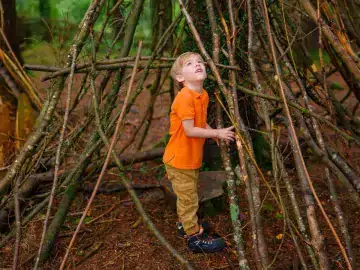
  1. Take a walk around your setting with learners to look for any outdoor spaces that could be used for nature play. These may be trees with low branches, a path through long grass or natural undulations in the space.  If your outdoor space is limited, any area with plenty of space for movement will work well.
  2. Provide a range of natural objects in varying sizes – logs, tree stumps, leaf piles, rope, twigs, bamboo canes – for learners to create obstacle courses for an ‘Insect Olympics’ in this space. You may be able to gather these from the ground around your site, but if materials are limited, you could add other loose parts that can become part of the obstacle course. 

    To discover more about loose parts play check out the Loose Parts Play Toolkit by Theresa Casey & Juliet Robertson.
  3. Children’s obstacle courses may involve tunnels to crawl through, platforms to jump from, floor ladders to tiptoe through and buckets or hoops. These activities will support body strength, balance, coordination and agility.  
  4. Keep the space set up, or keep materials nearby, so that learners can continue to use the play area.  
  5. Introduce new insects each week and allow learners time to imagine that they are the chosen insect, encouraging them to think about how the insect moves and behaves, and how it has adapted to live in its habitat. Support learners with open questions: ‘Where might that insect live?’ ‘What might it need to stay alive?’ ‘How might it move?’