
Pollinator Count - Expanded
In this survey, learners will count and record 10 groups of pollinating insects landing on flowers on their site, for either five or 10 minutes. The Pollinator Count Expanded can be done on any mild or sunny day between April and September, and no prior insect identification knowledge is needed!
Learners will see which plants are best for different insects and can use the count to monitor the impact of habitat changes, such as how adding wildflowers boosts pollinator diversity.
For more about the science behind the Pollinator Count, read our blog post.
This survey is based on the UK Pollinator Monitoring Scheme (PoMS) Flower-Insect Timed Count (FIT Count) method, adapted with their support. Learn more about UK PoMS and take part in FIT Counts anywhere by visiting UK Pollinator Monitoring Scheme
Preparation
If you are doing the survey digitally:
- flowering plants on your site
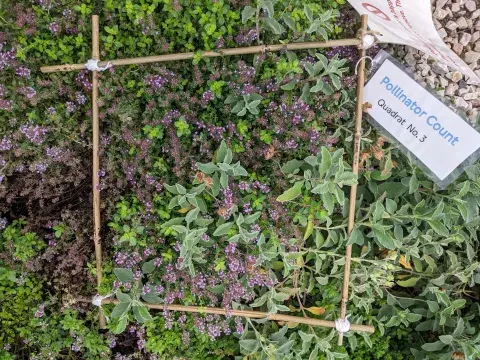
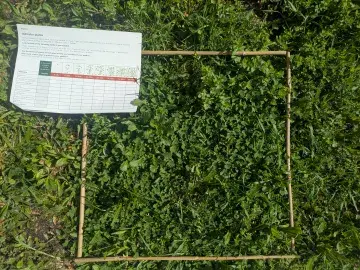
- 50cm x 50cm quadrats (home-made or shop bought) or 55-60cm hoops
- mobile devices with the Pollinator Count - Expanded open (access via the QR code below). You will need to login to your Nature Park account to do this
- printed resources: insect recording sheets and insect guides (download below)
- clipboards and pencils
- stopwatches or timers
If you are doing the survey on paper:
- flowering plants on your site
- 50cm x 50cm quadrats (home-made or shop bought) or 55-60cm hoops
- printed survey forms (download below)
- insect guides (download below)
- clipboards and pencils
- stopwatches or timers
- camera to take photos of your quadrat (if possible)
Upload your results when you come back into the classroom or in signal range. You must be logged into your Nature Park account to upload your results.
To upload your results, your site must already be on Nature Park Map. Add it to the Map by drawing your site boundary (5 mins).
Access the count

Location
Outdoors
Resources
Step by step
- Decide where on your site you want to do the count. If your site has already been mapped, use the habitat map to help choose your location. The planning and preparing your nature surveys page can give you ideas for what to investigate with your count.
- You can use the PowerPoint to introduce the survey to your group and distribute the survey materials.
- Divide your class into groups (three per group works well), head outside and place 50cm x 50cm quadrats over the patches of chosen flowers.
- Check your learners have entered the right date and time for the survey.
- If you have access to mobile devices, encourage your learners to take a photo of their quadrat and flowers, as asked for in the survey form.
- In the first part of the survey, when ready to start the Pollinator Count, each group will start a timer for 5 or 10 minutes.
- During this time, learners watch the flowers and tally how many of each type of insect LANDS on the ‘chosen flowers’ within their quadrat (on the open flowers, not leaves or buds)
- In the second part of the survey, learners will:
- Answer the questions about the weather conditions
- Have a go at identifying the ‘chosen flower’ – what do they think it is called? If you like, you could use iNaturalist to identify it.
- Record the quantity and coverage of the ‘chosen flower’ and any other flowers.
- Complete the insect identification quiz. This simple activity allows researchers to confirm the data accuracy when analysing the results.
- If the survey is being done on a mobile device, learners submit their results. If doing it on paper, learners return inside and enter the survey results online – see them appear on the Nature Park Map!
Why not repeat this count in a second habitat? It’s a great opportunity for learners to compare pollinator biodiversity in different patches, supports learning through investigation and it’s a way to track the positive difference you are making over time.
The below video shows you what the online survey form looks like.
Reflection
Why was it important to do surveys in different spots? Why didn’t we do the count across all the flowers? Would the information we would get from surveying all flowers be different from the survey we did in a few flower patches?
Curriculum links
This is a community science activity that contributes directly to real scientific research for the Nature Park. Taking part in the activity can aid development of working scientifically, geography fieldwork and citizenship skills alongside consolidating science curriculum knowledge and enhancing nature education.
What to try next
The Grassland Plant Survey - Expanded
Begin activityThree ways to share your findings
Begin activity